


2014–2026 GMC Sierra 1500 Oil Type and Capacity Guide
The right oil and the right amount of it is the single biggest factor in how long your GMC Sierra 1500 stays on the road. Across thirteen model years, GMC has built the Sierra 1500 with five different engines — each with its own viscosity, dexos specification, and capacity. The wrong oil weight, the wrong specification, or the wrong volume can cost you a warranty claim or, in some cases, an engine.
This guide is organized by engine, not by model year, because oil specs follow the engine. Find your engine below — the one printed on the engine cover or shown in your owner’s manual — confirm the viscosity and capacity for your year, and you’re ready to change oil with confidence (or to bring it to our service team and know exactly what’s going in).
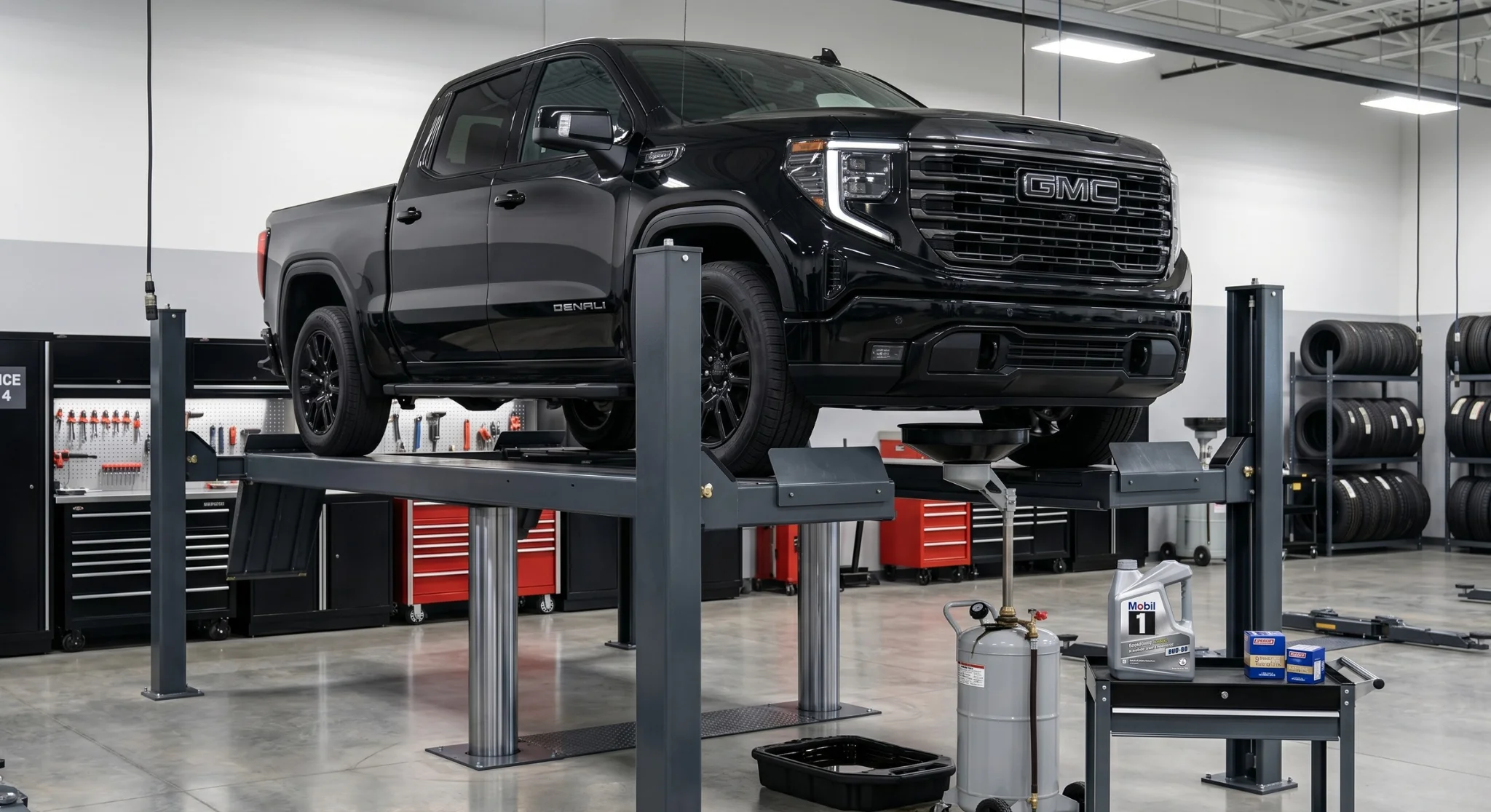
Find Your Engine
Not sure which engine is in your truck? Here’s a quick reference. The badge on the side of your hood or fender vent will usually tell you (especially on TurboMax, Duramax, and 6.2L Denali models), and your owner’s manual confirms it in the specifications section.
| Engine | Years in Sierra 1500 | What It’s Known For |
|---|---|---|
| 5.3L V8 | 2014 – present | The most common Sierra engine — balanced power and efficiency |
| 6.2L V8 | 2014 – present | Maximum gasoline power — Denali and AT4X workhorse |
| 2.7L Turbo / TurboMax | 2019 – present | Turbocharged four-cylinder — best-in-class torque, base engine |
| 3.0L Duramax Turbo-Diesel | 2020 – present | Inline-six diesel — top fuel economy, 13,300 lb tow capacity |
| 4.3L V6 | 2014 – 2021 | Former entry-level engine — discontinued after 2021 |
If you own a 2021–2024 Sierra 1500 with the 6.2L V8, also read the dedicated recall section below. There’s an active GM safety recall on that engine that has changed the recommended oil viscosity for affected vehicles.
5.3L V8 — 2014 to Present
The 5.3L V8 is the most common Sierra 1500 engine of the past thirteen years. GMC redesigned the engine in 2019, which changed the required oil viscosity. Find your model year in the table below.
Oil Specifications by Model Year
| Model Years | Viscosity | Specification | Capacity (with filter) | ACDelco Filter | Engine Code |
|---|---|---|---|---|---|
| 2014–2018 | SAE 5W-30 | dexos1 (Gen 1, then Gen 2 from 2015) | 8.0 qt (7.6 L) | PF63 | L83 |
| 2019–present | SAE 0W-20 | dexos1 Gen 2, then Gen 3 from 2021 | 8.0 qt (7.6 L) | PF63 | L84 |
What Changed in 2019
When GMC redesigned the Sierra 1500 for the 2019 model year, the 5.3L V8 received Dynamic Fuel Management (DFM) — an upgrade from the older Active Fuel Management system. DFM can deactivate any combination of the eight cylinders for better fuel economy, but it required thinner oil to maintain consistent hydraulic pressure inside the lifters that manage the cylinder shutdown.
Practical takeaway: If you have a 2018 or older 5.3L Sierra, run 5W-30. If you have a 2019 or newer 5.3L Sierra, run 0W-20. Using 5W-30 in a 2019+ truck can interfere with DFM operation; using 0W-20 in a pre-2019 truck isn’t engineered for that engine and may show up in fuel economy and long-term wear.
Note on Capacity
GM originally published 8.5 quarts as the capacity for the 2014–2015 5.3L V8. They later issued a service bulletin correcting the published capacity to 8.0 quarts after field reports of overfilling. The dipstick reading is the final authority — fill to the upper mark and verify.
6.2L V8 — 2014 to Present
The 6.2L V8 is GMC’s most powerful gasoline engine, standard on Denali Ultimate and available across the upper trims. Like the 5.3L, the engine was redesigned in 2019 with new viscosity requirements. If you own a 2021–2024 Sierra 1500 with this engine, see the recall section below — your oil specification may have changed.
Oil Specifications by Model Year
| Model Years | Viscosity | Specification | Capacity (with filter) | ACDelco Filter | Engine Code |
|---|---|---|---|---|---|
| 2014–2018 | SAE 5W-30 | dexos1 (Gen 1, then Gen 2 from 2015) | 8.0 qt (7.6 L) | PF63 | L86 |
| 2019–2020 | SAE 0W-20 | dexos1 Gen 2 | 8.0 qt (7.6 L) | PF63 | L87 |
| 2021–2024 (non-recalled) | SAE 0W-20 | dexos1 Gen 3 | 8.0 qt (7.6 L) | PF63 | L87 |
| 2021–2024 (recalled, post-inspection) | SAE 0W-40 | dexos R | 8.0 qt (7.6 L) | PF63 | L87 |
| 2025–2026 | SAE 0W-20 | dexos1 Gen 3 | 8.0 qt (7.6 L) | PF63 | L87 |
Important: 2021–2024 6.2L V8 Safety Recall
In 2024, GM issued a safety recall affecting approximately 600,000 vehicles equipped with the 6.2L V8, built between the 2021 and 2024 model years. The recall covers the 2021–2024 GMC Sierra 1500, Yukon, and Yukon XL, along with their Chevrolet and Cadillac counterparts. The recall was issued in response to a supplier-related issue involving potential rod bearing contamination and crankshafts that may fall outside specification, which can lead to engine damage or sudden loss of propulsion.
The recall remedy works in two stages. Affected vehicles must be brought in for an engine inspection. If the engine passes inspection, the dealer changes the oil to a higher-viscosity Mobil 1 0W-40 (meeting GM’s dexos R specification) and replaces the oil fill cap to reflect the new viscosity. If the engine fails inspection, GM replaces the engine — and the new engine returns to the original 0W-20 specification.
If you own a 2021–2024 Sierra 1500 with the 6.2L V8, here is what to do:
- Check your VIN at nhtsa.gov/recalls to confirm whether your vehicle is included in the recall.
- If it is, contact our service department — there is no charge for the recall inspection and the oil change service, and your engine is covered by GM’s extended warranty if the inspection passes.
- Do not switch back to 0W-20 after a recall-mandated 0W-40 oil change. The thicker viscosity is now the permanent specification for inspected, non-replaced engines.
2.7L Turbo / TurboMax — 2019 to Present
The 2.7L turbocharged four-cylinder debuted in the 2019 Sierra 1500 redesign as the new base engine and was rebranded “TurboMax” starting with the 2024 model year. The engine itself has remained mechanically the same throughout — only the name changed.
Oil Specifications by Model Year
| Model Years | Marketed As | Viscosity | Specification | Capacity (with filter) | ACDelco Filter |
|---|---|---|---|---|---|
| 2019–2023 | 2.7L Turbo | SAE 5W-30 | dexos1 (Gen 2, then Gen 3 from 2021) | 6.0 qt (5.7 L) | PF66 |
| 2024–present | 2.7L TurboMax | SAE 5W-30 | dexos1 Gen 3 | 6.0 qt (5.7 L) | PF66 |
Common Confusion: Why 5W-30 Instead of 0W-20
This is the single most common oil question we get from Sierra 1500 owners. The 5.3L and 6.2L V8s in the same trucks call for 0W-20 — so it would seem reasonable that the 2.7L should as well. It does not.
Turbocharged engines run their turbo bearings at shaft speeds exceeding 150,000 RPM, generating temperatures that can carbonize thinner oils. The 5W-30 viscosity provides the film strength needed to protect those bearings under sustained boost. Using 0W-20 in a 2.7L Turbo or TurboMax may interfere with turbo protection and is not approved by GMC. The oil fill cap on your engine confirms the correct viscosity — when in doubt, that’s the final word.
3.0L Duramax Turbo-Diesel — 2020 to Present
The 3.0L Duramax inline-six diesel arrived in the 2020 Sierra 1500. It received an upgrade for the 2023 model year that increased horsepower and torque, but the oil specification did not change.
Oil Specifications by Model Year
| Model Years | Viscosity | Specification | Capacity (with filter) | ACDelco Filter | Engine Code |
|---|---|---|---|---|---|
| 2020–2022 | SAE 0W-20 | dexosD (diesel-specific) | 7.0 qt (6.6 L) | PF66 | LM2 |
| 2023–present | SAE 0W-20 | dexosD (diesel-specific) | 7.0 qt (6.6 L) | PF66 | LZ0 |
Critical: dexosD Is Not the Same as dexos1
The 3.0L Duramax requires dexosD-certified oil. This is a completely separate specification from the dexos1 used in GMC’s gasoline engines, formulated specifically for diesel engines with modern emissions equipment (selective catalytic reduction and diesel particulate filters).
Using a standard dexos1 0W-20 — even though the viscosity grade matches — can damage your emissions aftertreatment system, void your warranty, and lead to expensive repairs. dexosD oils have reduced sulfated ash, phosphorus, and sulfur content specifically to protect those components. Always look for “dexosD” on the bottle, not “dexos1.”
4.3L V6 — 2014 to 2021
The 4.3L V6 was the entry-level engine in the Sierra 1500 from 2014 through 2021, when GMC retired it from the truck lineup in favor of the 2.7L Turbo as the base engine.
Oil Specifications
| Model Years | Viscosity | Specification | Capacity (with filter) | ACDelco Filter | Engine Code |
|---|---|---|---|---|---|
| 2014–2021 | SAE 5W-30 | dexos1 (Gen 1, then Gen 2, then Gen 3 from 2021) | 6.0 qt (5.7 L) | PF48 | LV3 |
The 4.3L V6 used the same 5W-30 specification throughout its Sierra 1500 production run. In sustained cold-weather conditions, GM’s owner’s manual permitted SAE 0W-30 as an alternative for improved cold-cranking — a detail worth knowing for owners in cold-climate regions, though less relevant in North Texas.
Understanding the dexos Specifications
GMC enforces strict dexos standards across all its engines. The specification is not just an industry recommendation — it’s a proprietary GM standard, and using oil that doesn’t carry the dexos certification can void portions of your warranty.
| Specification | Used In | Introduced |
|---|---|---|
| dexos1 Gen 1 | 2011–2015 GM gasoline engines | 2011 |
| dexos1 Gen 2 | 2015–2020 GM gasoline engines (added LSPI protection) | 2015 |
| dexos1 Gen 3 | 2021+ GM gasoline engines (current standard) | 2021 |
| dexos R | Performance engines and recalled 6.2L V8s requiring 0W-40 | Updated 2024 for recall use |
| dexosD | All GM diesel engines (Duramax) | Diesel-specific |
The good news for owners of older trucks: dexos1 Gen 3 is backwards-compatible with dexos1 Gen 2 and Gen 1 applications. If you own a 2016 Sierra 1500 with the 5.3L V8, current dexos1 Gen 3 0W-20 is fine to use — actually preferred, since it incorporates improvements in oxidation resistance, deposit control, and turbocharger protection over the older specifications.
The reverse is not true. Putting a dexos1 Gen 2 oil in a 2021+ engine that specifies Gen 3 means operating slightly outside specification. Practically, it isn’t dangerous if it happens once at a quick-lube shop that’s out of stock — but the next change should return to the current specification.
Service Intervals: What GMC Actually Recommends
GMC’s official guidance is to follow the Oil Life Monitor in your instrument cluster, not a fixed mileage interval. The Oil Life Monitor uses engine temperature, RPM, load, and runtime data to calculate when your oil has degraded enough to require replacement.
In practice, the Oil Life Monitor typically signals an oil change between 7,500 and 10,000 miles for highway-heavy normal driving with full synthetic oil. Owners who tow regularly, drive primarily in stop-and-go conditions, leave the truck idling for long periods, or operate on dusty job-site roads will see the monitor trigger closer to 5,000 miles. GMC also recommends an oil change at least once every 12 months regardless of mileage — full synthetic oil resists oxidation well, but it isn’t immune to time.
For Sierra 1500 owners in the Waxahachie, Midlothian, and Ennis area, summer heat is the most relevant factor that shortens oil life beyond what the monitor might predict. Sustained ambient temperatures above 95°F, combined with towing or hauling, accelerate oxidation. If your truck sees heavy summer use, consider treating any reading at or below 30% oil life as the threshold to schedule service.
Filters Matter as Much as Oil
Using the correct ACDelco oil filter is just as important as using the correct oil. Each filter is engineered for the specific flow rate, pressure tolerance, and contamination filtration requirements of its engine.
| Engine | ACDelco Filter (OEM) |
|---|---|
| 4.3L V6 | PF48 |
| 5.3L V8 | PF63 |
| 6.2L V8 | PF63 |
| 2.7L Turbo / TurboMax | PF66 |
| 3.0L Duramax Turbo-Diesel | PF66 |
Aftermarket filters that claim “dexos approval” or “GM equivalent” may meet the specification, but the OEM ACDelco filters are what GM engineered the engine around. For warranty service and for any truck under powertrain coverage, ACDelco is the safest choice.
Frequently Asked Questions
Can I use 5W-30 instead of 0W-20 in my 2019+ Sierra with the 5.3L or 6.2L V8?
No. The 2019+ 5.3L and 6.2L V8s were engineered around 0W-20 viscosity to support the Dynamic Fuel Management system, which relies on consistent hydraulic pressure inside the cylinder-deactivation lifters. Using a thicker viscosity can interfere with operation and may show up as fuel economy loss or eventual lifter problems. The exception is the recalled 2021–2024 6.2L V8s that have passed recall inspection — those require 0W-40 per the GM recall remedy.
Does the published oil capacity include the filter?
Yes. The capacities listed in this guide (and in GM’s official service literature) are with-filter specifications. A new filter holds a small amount of oil, so the figure represents the total volume needed after a complete oil and filter change. Always verify the level on the dipstick after running the engine briefly and letting it sit for a minute.
Is dexosD interchangeable with dexos1?
No, and this is a critical distinction. dexosD is formulated for diesel engines with selective catalytic reduction and diesel particulate filter aftertreatment. It has reduced levels of sulfated ash, phosphorus, and sulfur compared to dexos1. Using dexos1 in a 3.0L Duramax can poison the aftertreatment system and lead to expensive repairs, often not covered by warranty.
My 2024 Sierra 1500 6.2L V8 has the new 0W-40 fill cap. Do I keep using 0W-40 forever?
Yes. The 0W-40 dexos R specification is the permanent replacement viscosity for 6.2L V8s that passed the recall inspection. The oil fill cap was replaced to reflect this change. Continue with 0W-40 dexos R at every subsequent oil change — do not revert to 0W-20.
My older Sierra calls for dexos1 Gen 2. Can I use Gen 3?
Yes. GM designed dexos1 Gen 3 to be backwards-compatible with Gen 2 and Gen 1 applications. Owners of 2014–2020 Sierras can use current dexos1 Gen 3 oil with no concern — and they’ll benefit from the improvements in oxidation resistance and deposit control that Gen 3 introduced.
How often should I actually change my oil?
Follow the Oil Life Monitor as the primary guide. Most normal-service Sierra 1500 owners see the monitor trigger between 7,500 and 10,000 miles. Severe-service owners (frequent towing, dusty conditions, extended idling, short trips) see it closer to 5,000 miles. Regardless of mileage, change oil at least once every 12 months.
Disclaimer
The information in this guide is provided for general reference and is compiled from GMC owner’s manuals, GM service literature, and authoritative technical sources current as of publication. Oil specifications, capacities, recall remedies, and dexos requirements can be revised by General Motors at any time. Your vehicle’s owner’s manual and the oil fill cap on your specific engine are the final authority for your truck’s oil requirements. For VIN-specific verification — especially regarding open recalls, warranty coverage, or revised oil specifications — contact our service department or check your VIN at nhtsa.gov/recalls. Legacy GMC of Waxahachie is not responsible for engine damage, warranty issues, or service outcomes resulting from oil decisions made based on general reference information; when in doubt, schedule a service appointment so our technicians can verify the correct specification for your vehicle.
Schedule Service at Legacy GMC of Waxahachie
If you’d rather skip the parts-store guessing and let factory-trained technicians handle your Sierra 1500’s oil service, we use the correct ACDelco filter and the exact dexos-certified oil specified for your engine — every time. Our service team verifies your VIN against open recalls, including the 6.2L V8 recall, so you’ll know exactly where your truck stands.
For service-related questions, our service department is reachable at 469-553-0877. Legacy GMC of Waxahachie is located at 1701 US-287 Bypass, serving Sierra 1500 owners throughout Waxahachie, Midlothian, and Ennis.
Considering an Upgrade?
If your current Sierra is aging out of warranty coverage and you’re starting to weigh service costs against upgrade options, our 2026 Sierra 1500 research page walks through what’s new on the current model, and you can browse our new Sierra 1500 inventory anytime.